

Nitrile vs Latex vs Vinyl Gloves: Which Should You Buy?
Your mom is home after surgery, and the visiting nurse just showed you how to change her dressing. "Wear gloves," she says on her way out. You go to order a box and find three materials, dozens of brands and prices that range from a few dollars to more than fifty.
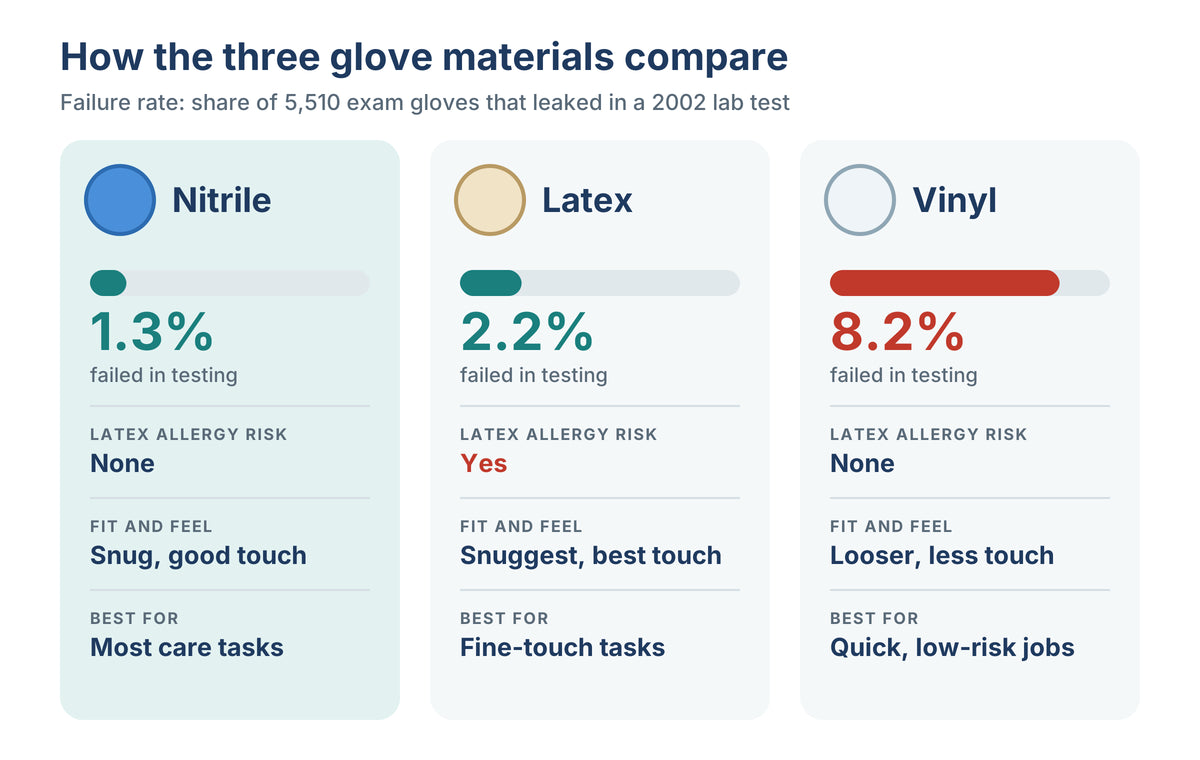
Choosing between nitrile vs latex vs vinyl gloves matters more than it looks. In one lab test of 5,510 exam gloves, 1.3% of nitrile gloves failed, compared with 2.2% of latex and 8.2% of vinyl.1 Below, you'll see how each material compares on protection, allergy risk, fit and cost, plus which glove fits which task at home or in a clinic.
The quick answer
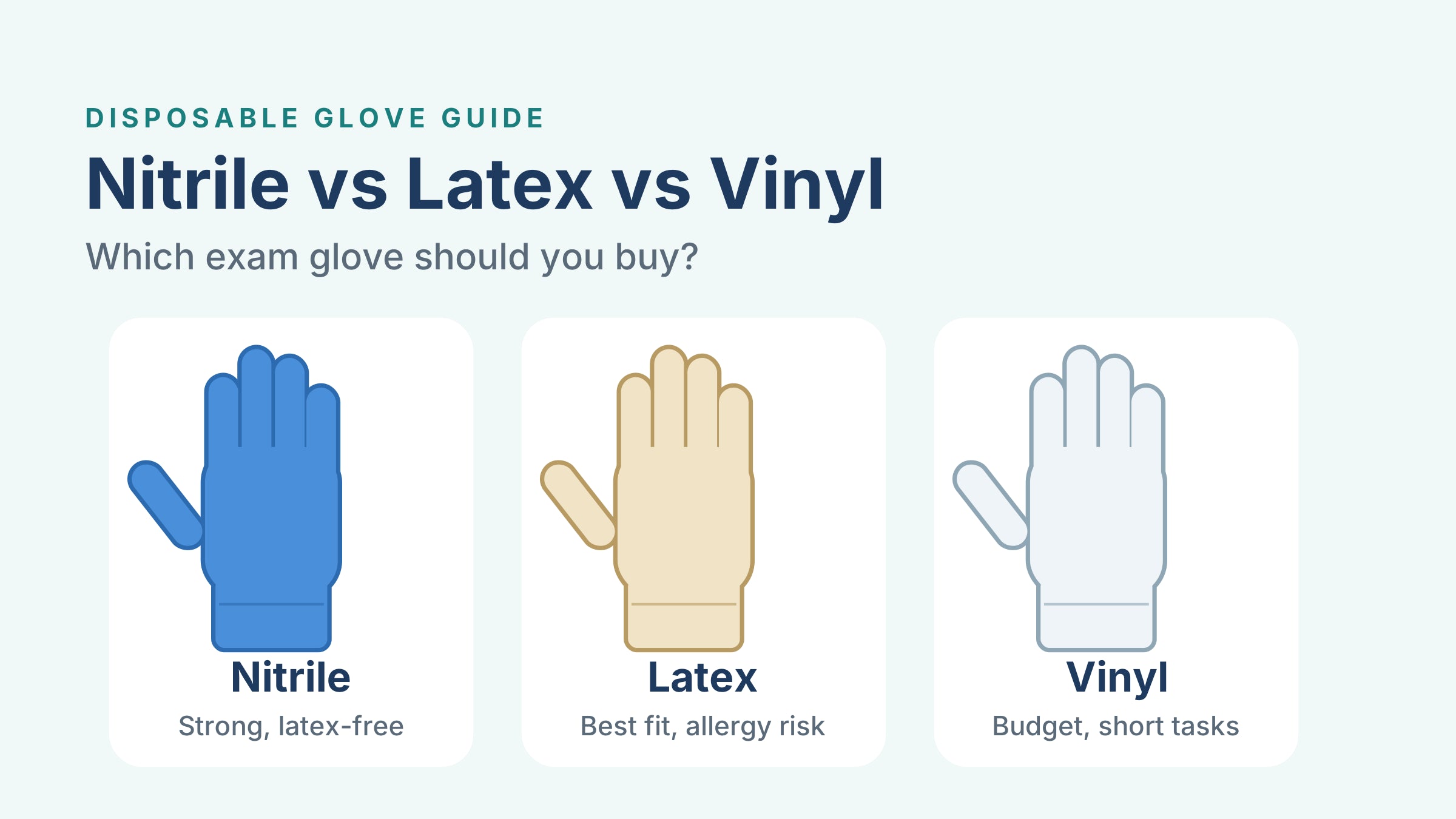
- Not sure? Buy nitrile. It's latex-free, strong and suits most care tasks, including blood and body fluids.
- Latex has the best stretch and feel, but only if no one wearing the gloves or receiving care is allergic.
- Vinyl is a budget glove for quick, low-risk jobs like food prep or light cleaning.
- Anyone in the home allergic to latex? Skip latex entirely and choose nitrile or vinyl.2
What Makes a Glove a Medical Exam Glove?
Before comparing materials, it helps to know what "exam glove" means on the box. In the U.S., disposable medical exam gloves are medical devices. The FDA reviews them before they're sold and requires the label to list what the glove is made of.2
The FDA also sets a minimum quality bar for holes and other defects, called the AQL (acceptable quality level). Exam gloves must meet an AQL of 2.5, and surgical gloves meet a stricter 1.5. A lower number means fewer defects are allowed.3
One more thing has changed: powdered medical gloves are banned. The FDA removed powdered exam and surgical gloves from the market in January 2017, partly because the powder can carry latex proteins into the air.4 Any medical glove you buy today should be powder-free.
Nitrile Gloves: The All-Round Default
If you only keep one kind of glove in the house, make it this one.
Nitrile gloves are made from a synthetic rubber. They contain no natural latex, stretch well and hold up to oils, many chemicals and hours of wear. They come in blue, purple, black and other colors, and many have textured fingertips for grip.
What it looks like in real life: You're changing a wound dressing that's still draining, then helping with a bath. You use a fresh pair of nitrile gloves for each task and don't worry about tears or latex allergies.
Best for: Wound care, incontinence care, contact with blood or body fluids, cleaning with chemicals, and anyone with a latex allergy.
Skip it when: You get an itchy rash from nitrile gloves. Some nitrile gloves contain the same chemical "accelerators" used in latex gloves, which can cause a delayed skin allergy.5 An accelerator-free glove may help.
Change it: After every task, or right away if it tears.
What the research says about nitrile gloves
In the largest test of its kind, researchers water-tested 5,510 exam gloves, some straight from the box and some after a set routine of stretching and handling. Nitrile had the lowest failure rate at 1.3%. After adjusting for brand and stress, latex gloves were about 3 times more likely to fail than nitrile.1
Keep the limits in mind. That study is from 2002, glove formulas have changed since, and the authors described their sample size as limited.1 Results also vary by brand, so a quality nitrile glove matters more than the word "nitrile" alone.
Latex Gloves: Best Fit and Feel, If No One Is Allergic
Like a second skin, with one big catch.
Latex gloves are made from natural rubber. They're very elastic, fit snugly and give excellent fingertip feel, which is why many nurses and dentists still like them. Today's medical latex gloves are powder-free,4 and many are labeled low-protein to reduce allergy risk.
What it looks like in real life: You check blood sugar and handle small dressings for a family member with no allergies. You like how latex gloves let you feel tiny lancets and tape edges.
Best for: Tasks that need fine touch and a close fit, when no one involved has a latex allergy.
Skip it when: Anyone wearing the gloves or receiving care has a latex allergy or a higher risk of one. That includes people with spina bifida, people who had many surgeries as children, and people allergic to foods like avocado, banana, chestnut or kiwi.6
Change it: After every task, or right away if it tears.
What the research says about latex allergy
Latex allergy is not rare. A 2016 review of studies worldwide found that about 4.3% of the general population and 9.7% of health care workers have a latex allergy.7 Reactions range from a rash to anaphylaxis, a life-threatening allergic reaction.6
The good news is that the risk has fallen. When latex allergy peaked, 8% to 12% of U.S. health care workers showed signs of sensitization, and moving away from powdered latex gloves was linked to fewer new cases.8 That's part of why many hospitals now stock nitrile instead.
Vinyl Gloves: A Budget Pick for Short, Low-Risk Tasks
Fine for a sandwich. Not for a wound.
Vinyl gloves are made from PVC, a plastic. They're latex-free, usually the cheapest option and easy to pull on and off. The tradeoff is a looser fit and less stretch, so they can tear or develop tiny holes with heavy use.
What it looks like in real life: You're making lunch for someone you care for, wiping a counter or applying lotion. These jobs are quick and don't involve blood, so a vinyl glove does the job.
Best for: Food prep, light cleaning and short tasks with little risk of contact with blood or body fluids.
Skip it when: You'll handle blood, body fluids or harsh chemicals, or wear the gloves for a long time. Choose nitrile instead.
Change it: Often. Vinyl breaks down faster with stretching and movement.
What the research says about vinyl gloves
In the 2002 test, vinyl gloves failed at 8.2%, more than six times the rate of nitrile.1 An earlier lab study found the gap widens with use: after the heaviest handling, 63% of vinyl gloves let a test virus through, compared with 7% of latex gloves.9
Both studies are older, and newer "stretch" or "synthetic" vinyl gloves are designed to fit better. Still, no newer research shows vinyl matching nitrile for durability, so treat vinyl as a short-task glove.
Nitrile vs Latex vs Vinyl Gloves Compared
| Nitrile | Latex | Vinyl | |
|---|---|---|---|
| Made from | Synthetic rubber | Natural rubber | PVC plastic |
| Failure rate in testing1 | 1.3% | 2.2% | 8.2% |
| Latex allergy risk | None | Yes | None |
| Accelerator skin allergy5 | Possible | Possible | Unlikely (not rubber) |
| Fit and feel | Snug, good touch | Snuggest, best touch | Looser, less touch |
| Typical cost | Mid | Mid | Lowest |
| Best for | Most care tasks | Fine-touch tasks, no allergies | Quick, low-risk tasks |
Failure rates are from one 2002 lab study; results vary by brand.
How to Choose Disposable Gloves by Task
The right glove depends on what you're doing and who you're caring for. Use this as a starting point:
- Wound care and dressing changes: Nitrile, or latex if no one is allergic. Learn which dressing fits which wound in our guide to types of wound dressings.
- Incontinence care and bathing: Nitrile, since these tasks involve body fluids and lots of movement.
- Blood sugar checks and injections: Nitrile or latex for good fingertip feel. Clean the skin first with an alcohol prep pad.
- Handling chemotherapy medicines at home: Ask the oncology team. Chemotherapy gloves are a separate category,2 and many are nitrile gloves tested to a standard called ASTM D6978.
- Food prep and light cleaning: Vinyl is fine. Use nitrile for strong cleaning chemicals.
- Someone has a latex allergy: Nitrile or vinyl only, for everyone in the home who gives care.2
How to read a glove box label
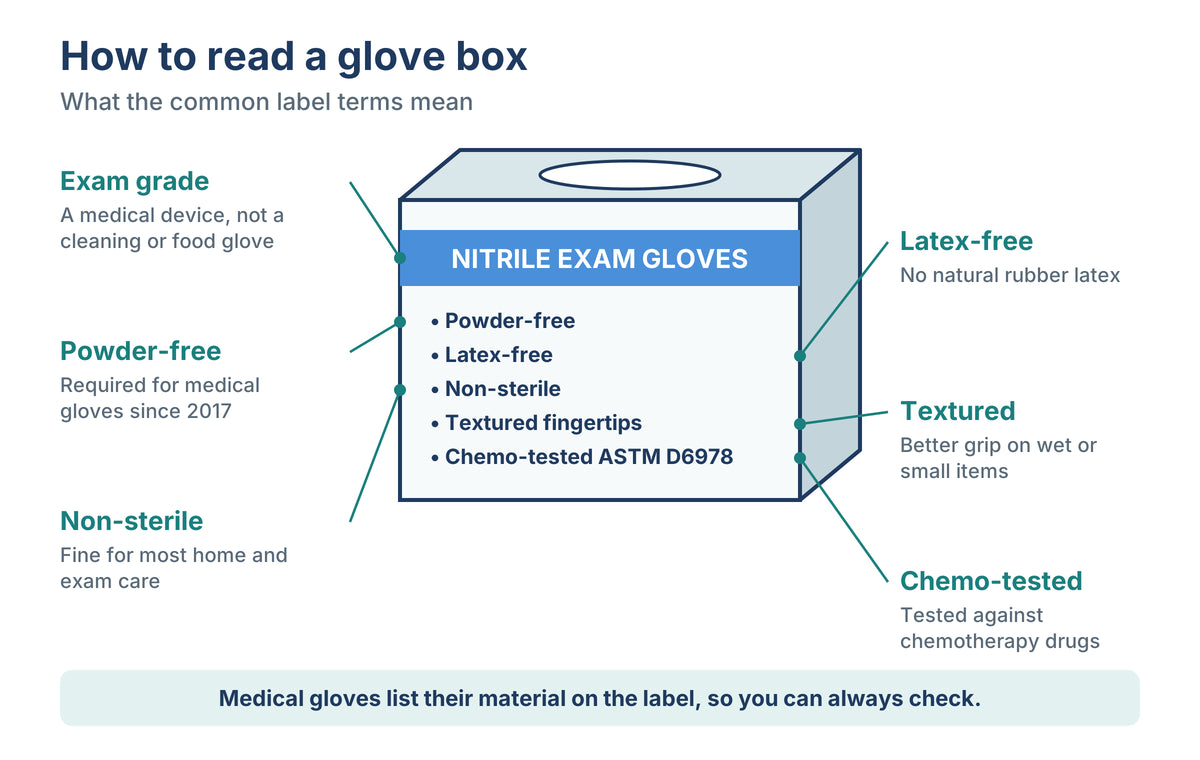
- Exam grade: Made and tested as a medical device, not just a cleaning or food glove.2
- Powder-free: Standard for medical gloves since the 2017 ban.4
- Latex-free: Contains no natural rubber latex. Nitrile and vinyl are latex-free.
- Non-sterile vs sterile: Non-sterile gloves come loose in a box and suit most home and exam care. Sterile gloves come in sealed pairs for procedures your care team says need them.
- Textured fingertips: Better grip on wet or small items.
- Chemo-tested (ASTM D6978): Tested against chemotherapy drugs.
Where to Buy Nitrile, Latex and Vinyl Exam Gloves
Medicinal Supplies carries exam gloves in all three materials from established medical brands. All of these are powder-free and non-sterile:
| Glove | Material | Worth knowing | Gloves per box |
|---|---|---|---|
| Cardinal Health Esteem Stretchy | Nitrile | Soft, stretchy everyday glove | 150 |
| Cardinal Health Flexal Touch | Nitrile | Chemo-tested to ASTM D6978 | 250 |
| Ansell Micro-Touch NitraFree | Nitrile | Made without sulfur-based accelerators; chemo-tested | 100 |
| Ansell Micro-Touch Nextstep | Latex | Textured, low residual protein | 100 |
| Cardinal Health Latex | Latex | Budget latex exam glove | 100 |
| Dynarex Safe-Touch | Latex | Textured, low protein | 100 |
| Ansell Micro-Touch Elite | Vinyl | Smooth, cream colored | 100 |
| Ammex Professional | Vinyl | Clear, 4 mil | 100 |
| Cardinal Health Stretchy Synthetic | Vinyl | Stretch vinyl for a closer fit | 130 to 150 |
Box counts vary by size, and most come in money-saving cases of 10 boxes. Compare all brands and sizes in our medical exam gloves collection.
How to Use Disposable Gloves Safely
A good glove only works if you use it well. These four habits matter most:
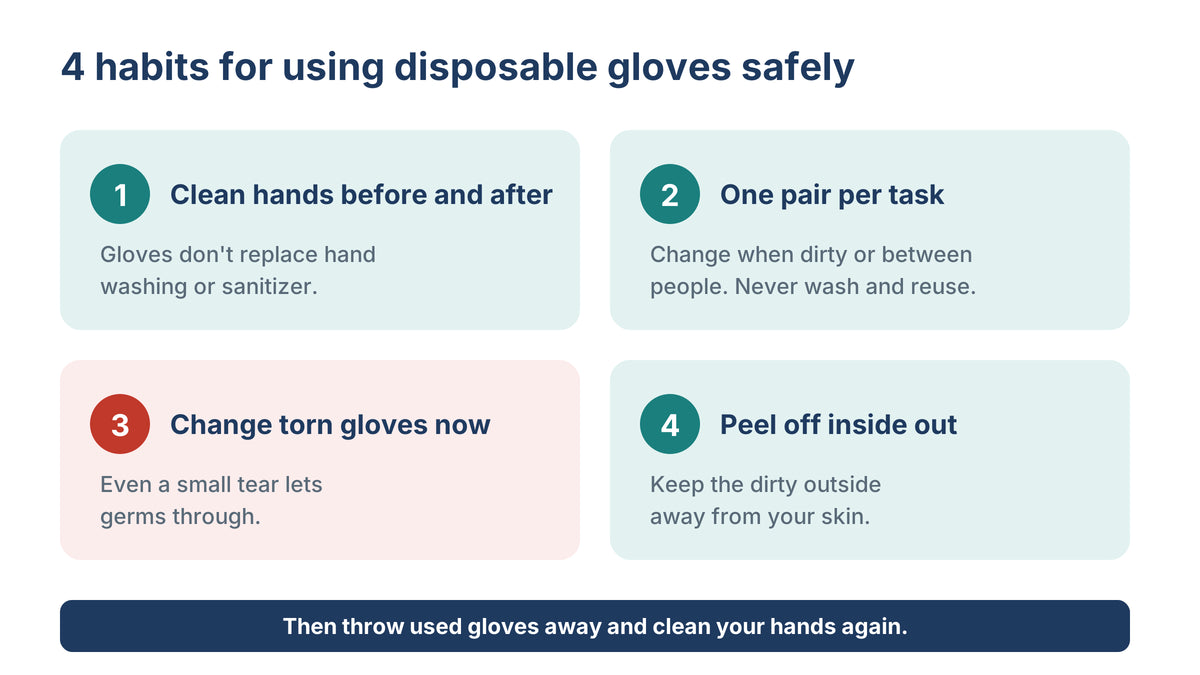
- Clean your hands before and after. Gloves don't replace hand washing. Clean your hands before putting gloves on and every time you take them off.10
- Use one pair per task. Change gloves when they look dirty or have blood or body fluids on them, and when you move from one person to another.10 Disposable gloves are single-use, so don't wash and reuse them.2
- Change torn gloves right away. A small tear lets germs through, so swap the pair and clean your hands.10
- Take them off carefully. Peel each glove off inside out so the dirty outside never touches your skin, then throw them away. Careful removal keeps germs off your hands.10
Store boxes somewhere cool and dry, out of direct sunlight, and check the expiration date printed on older boxes.
When to call your provider
Most glove problems are minor, but some reactions need medical care:
- You get hives, itching, swelling or other allergy signs soon after wearing or touching latex gloves.6
- An itchy rash on your hands keeps coming back, even with latex-free gloves. A doctor can test for accelerator allergy.5
- A glove tore while you were handling blood and you have a cut or broken skin on your hands.
- The person you care for has a skin reaction where your gloved hands touched them.
Call 911 for signs of a severe allergic reaction, such as trouble breathing or swelling of the face, lips or throat.
The Bottom Line on Nitrile vs Latex vs Vinyl Gloves
For most people, nitrile is the safest all-round choice: it's latex-free, tough and failed least often in testing. Latex gives the best fit when no one has an allergy, and vinyl is a fine low-cost glove for quick, low-risk jobs.
Stock up on powder-free nitrile, latex and vinyl exam gloves from Cardinal Health, Ansell, Dynarex and more, by the box or case.
Sources
- According to a 2002 study in the American Journal of Infection Control that water-tested 5,510 nitrile, latex, copolymer and vinyl exam gloves. Source ↩
- According to the U.S. Food and Drug Administration, "Medical Gloves." Source ↩
- According to FDA regulation 21 CFR 800.20 on patient examination gloves and surgeons' gloves. Source ↩
- According to the FDA's final rule banning powdered gloves, published in the Federal Register on December 19, 2016. Source ↩
- According to a 2021 review in Allergologie Select on allergic contact dermatitis from rubber accelerators in protective gloves. Source ↩
- According to StatPearls, "Latex Allergy," from the National Library of Medicine, updated July 2023. Source ↩
- According to a 2016 review of latex allergy prevalence studies in the Journal of Occupational Health. Source ↩
- According to the National Institute for Occupational Safety and Health (NIOSH), "Preventing Occupational Latex Allergy in Health Care Workers." Source ↩
- According to a 1990 study in the Journal of Clinical Microbiology on virus leakage through used vinyl and latex exam gloves. Source ↩
- According to the Centers for Disease Control and Prevention, "Clinical Safety: Hand Hygiene for Healthcare Workers." Source ↩
Medical disclaimer: This article is for general education only and is not medical advice. It does not replace guidance from your doctor, nurse or other health care provider. If you have or suspect a latex allergy, or you care for someone with special infection-control needs, ask your care team which gloves to use. Medicinal Supplies sells the gloves mentioned in this article.