


Types of Wound Dressings: Which One Does Your Wound Need?
It's 9 p.m. The home health nurse said to "keep it covered with something absorbent until Thursday," and now you're staring at a shelf, or a website, full of pads, wafers, ropes and gels. Every box promises "advanced healing." None of them tells you which one your wound needs.
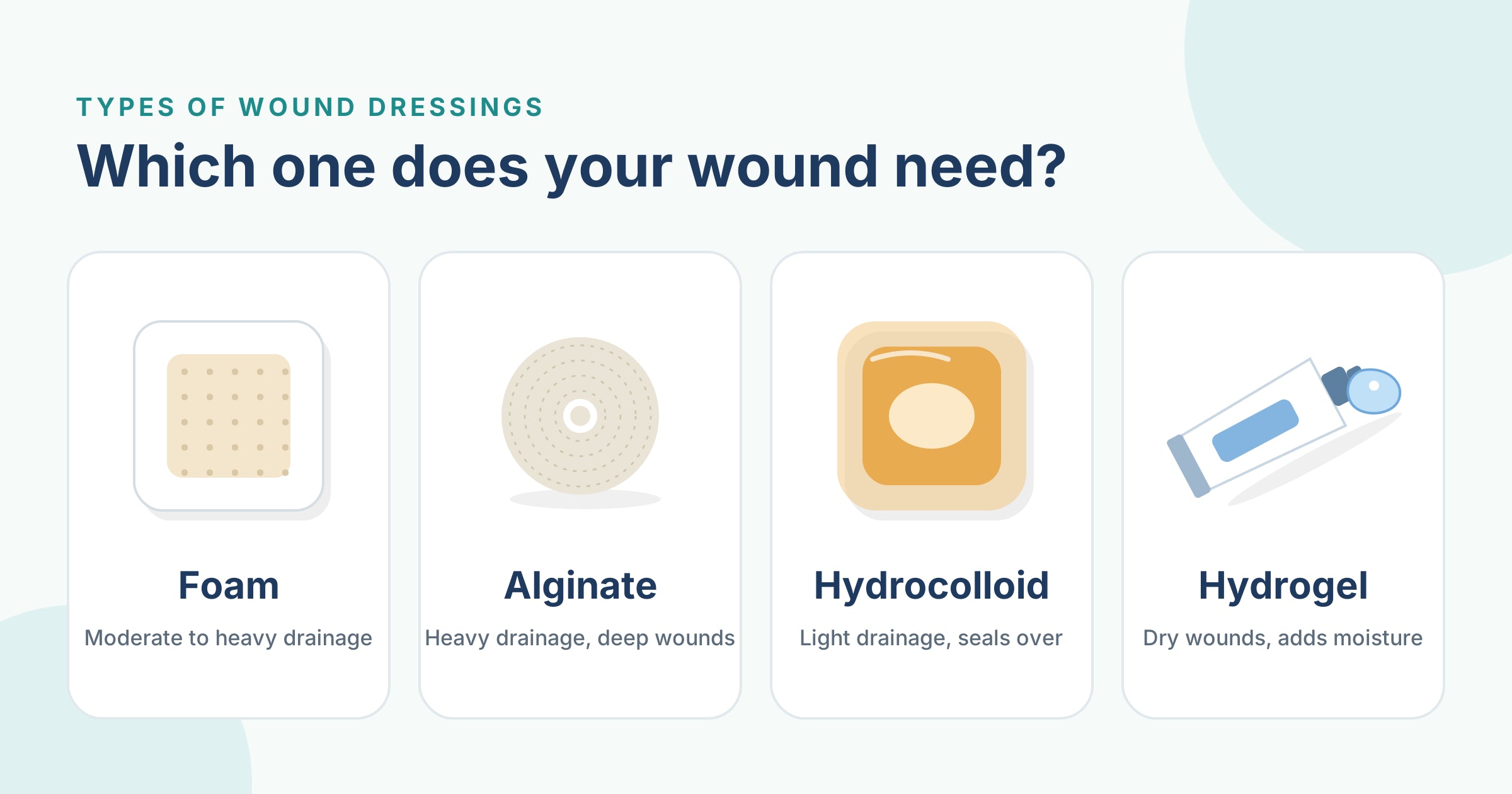
Here's the good news. The types of wound dressings you'll see most often come down to four, and picking between them mostly hinges on one question: how wet is the wound?
Wounds are more common than most people think. About 10.5 million people on Medicare had at least one wound in 2019, up from 8.2 million in 2014.1
The quick answer
- Dry wound? Hydrogel adds moisture.
- Light to moderate drainage? Hydrocolloid seals it in.
- Moderate to heavy drainage? Foam soaks it up.
- Heavy drainage, deep wound? Alginate fills the space and absorbs.
Keep reading for how each one works, when to skip it, how often to change it, and what to look for when you buy.
How Wound Dressings Work: The Goldilocks Rule of Moisture
For generations, the advice was to let a wound "air out" and scab over. Research flipped that. In a classic 1962 animal study, wounds kept moist under a thin film grew new skin about twice as fast as wounds left open to dry.2 That one finding is why almost every modern dressing is designed for moist wound healing.
But wetter isn't always better. Fluid that sits on the skin around a wound softens it and breaks it down, a problem called maceration.3 So the target is Goldilocks moisture: a wound bed that stays damp, surrounded by skin that stays dry.
What decides the right dressing
Clinicians look at a wound's depth, how much it drains, how long it's been open, and whether it's infected.3 In plain terms:
- Drainage (exudate): none, light, moderate or heavy. This is the big one.
- Depth: shallow wounds need a cover. Deep wounds and tunnels need a filler, plus a cover on top.
- What the wound bed looks like: pink and healthy, yellow and sloughy, or dry and black (eschar).
- Skin and infection: fragile skin, an infection or an adhesive allergy rules some options out.
Primary vs secondary dressings
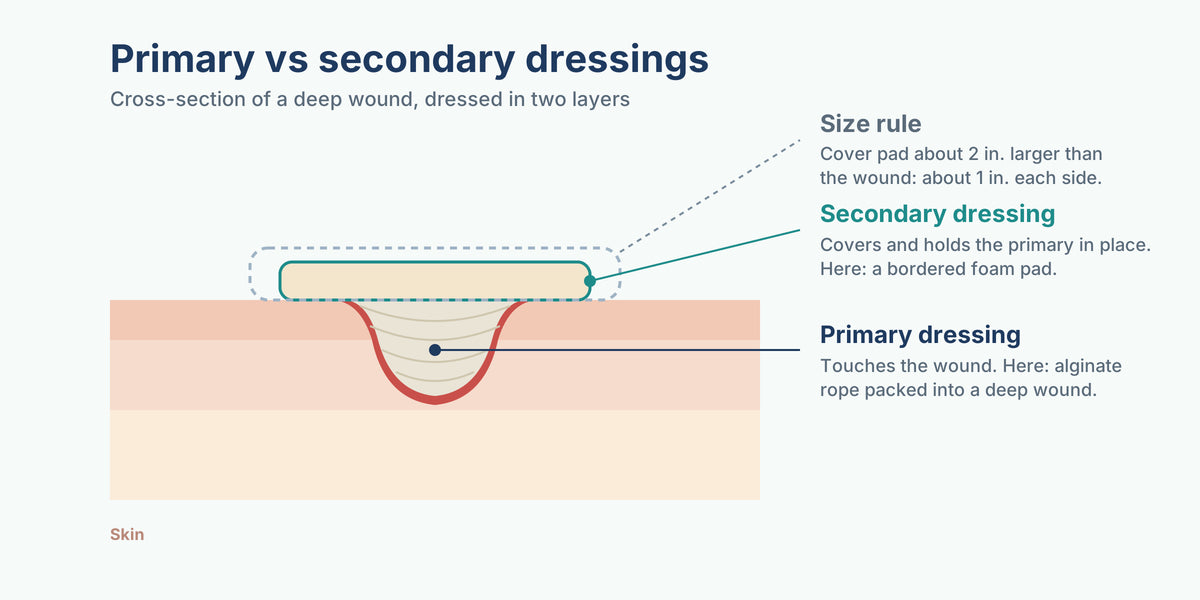
The primary dressing is whatever touches the wound. The secondary dressing sits on top to hold it in place or catch extra fluid. Alginate ropes and hydrogel from a tube always need a secondary cover. A bordered foam pad or a hydrocolloid wafer can usually work alone.
Two handy rules of thumb: the product touching the wound sets the change schedule, and a cover pad should be about 2 inches larger than the wound. A 2 x 2 inch wound, for example, typically gets a 4 x 4 inch pad.4
Foam Dressings: The Workhorse for Draining Wounds
Think of foam as a cushioned sponge wearing a raincoat.
A foam dressing is a soft polyurethane pad that soaks up fluid while keeping the wound bed moist. Most have a waterproof backing, and many add a gentle silicone border so you can skip the tape. The padding is a bonus on bony spots that take a beating.
What it looks like in real life: Your dad has a sore on his heel that leaves a damp spot on his sock by evening. That's moderate drainage on a bony area, a textbook job for a bordered foam.
Best for: Moderate to heavy drainage, chronic wounds and pressure injuries.3 Heels, hips and the tailbone. Leg wounds under compression wraps. Deep wounds, using a foam cavity filler under a cover.
Skip it when: The wound is dry or barely draining, because foam can dry it out.3 Dry, hard, black tissue (eschar) needs a provider's check first, especially on a heel or a diabetic foot.
Change it: Usually daily to a few times a week, depending on how much the wound drains.3 Your care team's schedule and the package directions come first.
Foam can help before a wound starts
An estimated 2.5 million people in the U.S. develop a pressure injury each year.5 In one hospital trial of 440 critically ill patients, those who wore multilayer silicone foam dressings on the sacrum and heels developed far fewer pressure injuries: 5 patients versus 20 with standard care.6 The dressing maker funded that study, so read it as promising rather than final.
Shopping tip: Bordered foam is the easiest choice for home care because it seals on its own. Non-bordered foam works better on fragile skin or under a wrap. Medicinal Supplies carries more than 160 foam dressings from Mölnlycke, Smith & Nephew, Ferris and more, in bordered, non-bordered, silicone and cavity styles.
Alginate Dressings: Seaweed That Turns Into Gel
Think of alginate as a dry sponge that melts into soft gel and fills every gap.
An alginate dressing is made from seaweed fibers. When it meets wound fluid, calcium in the fibers trades places with sodium in the fluid, and the dressing turns into a soft gel.3 That gel packs into the wound and holds a lot of drainage. Alginates come as flat pads and as ropes for deep wounds and tunnels, and the calcium even helps with minor oozing of blood.3
What it looks like in real life: A nurse is caring for a deep wound that soaks through plain gauze within hours. Packing it with alginate rope and covering it with foam keeps the fluid in check between visits.
Best for: Moderate to heavy drainage.3 Deep wounds, cavities and tunnels that need filling. Light surface bleeding.
Skip it when: The wound has little drainage,3 is dry, or is covered with eschar.4 Alginate needs fluid to work.
Change it: Usually every 1 to 3 days.3
Two things that surprise people
- It always needs a cover. Put foam, gauze or a bordered pad on top so it stays in place and doesn't dry out.3
- The used gel can look and smell alarming. Alginate has a known unpleasant odor, and the gel can turn yellow or brown. Both are easy to mistake for pus.3 Real warning signs look different; they're pictured further down.
What the research says about alginate
Alginate is great at managing fluid, but that doesn't make it a faster healer. A 2013 review of 6 trials with 375 people found no evidence that alginate healed diabetic foot ulcers better than other dressing types.7 Choose it for what it does best: handling heavy drainage in deep wounds.
Shopping tip: Medicinal Supplies stocks more than 30 alginate dressings, including pads, ropes and silver alginates, from Medline, Hartmann, Gentell, Mölnlycke and others.
Hydrocolloid Dressings: The Set-It-and-Forget-It Seal
Think of hydrocolloid as a second skin that turns soft and gel-like where it touches the wound.
A hydrocolloid dressing is a flexible, self-adhesive wafer made from gel-forming ingredients like cellulose, gelatin or pectin. At first it keeps water out. As it absorbs wound fluid, the side touching the wound slowly turns into a soft gel.3 It also comes as paste or powder for shallow cavities, and wafers bend well enough to sit across elbows and knees.3
What it looks like in real life: A shallow wound on the knee is healing well and barely leaves a mark on the dressing. A hydrocolloid can seal it for a few days, so there's no daily change to wrestle with.
Best for: Light to moderate drainage.4 Pressure wounds with minimal to moderate drainage.3 Anyone who wants a sealed, low-maintenance cover that stays on for days.
Skip it when: The wound is infected or has dead (necrotic) tissue,3 drains heavily, or needs checking every day, since you can't see through most hydrocolloids.3 Heavy drainage can also overwhelm the wafer and leak at the edges.
Change it: Usually every 2 to 4 days.3 Change it sooner if it leaks or lifts at the edges.
What the research says about hydrocolloids
Hydrocolloids win on convenience more than speed. A 2013 review of 5 trials with 535 people found no evidence that any hydrocolloid healed diabetic foot ulcers better than other dressings.8 Their real strengths are comfort and fewer changes on low-drainage wounds.
Shopping tip: Thin hydrocolloids suit nearly healed or very light-draining wounds. Thicker, bordered wafers hold more fluid. Medicinal Supplies carries thin, standard and bordered hydrocolloid wafers, plus a hydrocolloid filler paste.
Hydrogel Dressings: A Drink of Water for Dry Wounds
Think of hydrogel as moisturizer for a wound that has dried out.
Foam, alginate and hydrocolloid all soak fluid up. A hydrogel dressing does the opposite. It's mostly water held in a gel, so it adds moisture to a wound that's too dry.3 You'll find it as a gel in a tube (called amorphous hydrogel), as a firm sheet, or soaked into gauze.
Hydrogel feels cool, which can ease pain. Keeping dead tissue moist also lets the body's own enzymes soften and loosen it, a process called autolytic debridement.3
One important exception: dry, hard, black tissue on a heel or a diabetic foot should be checked by a provider before you try to soften it. Pressure injury guidelines say stable, dry eschar on the heel, or on a foot or leg with poor blood flow, should be left in place rather than softened or removed.9
What it looks like in real life: A wound has been covered in dry, yellowish tissue for a week, with almost no fluid on the dressing. The care team wants that tissue softened, and a thin layer of hydrogel under a cover is a common way to do it.
Best for: Dry wounds and wounds with minimal or no drainage.4 Dry slough or dead tissue that needs softening.3 Painful wounds where a cool layer helps.3
Skip it when: The wound drains heavily. Hydrogel holds very little fluid,3 and extra moisture on nearby skin can cause maceration.
Change it: Usually every 1 to 3 days.3
Two rules worth remembering: hydrogel usually needs a secondary dressing on top,3 and it is generally not used with an alginate on the same wound, since one adds moisture and the other pulls it away. Medicare's coverage rules don't pay for the two together either.4
What the research says about hydrogel
Hydrogel has some of the more encouraging data of the four. In a 2013 review of trials in people with diabetic foot ulcers, mostly less severe ones, wounds treated with hydrogel were about 1.8 times as likely to heal as those under basic contact dressings.10 The reviewers called that evidence uncertain because the trials were small and at risk of bias.
Shopping tip: Pick a tube gel for uneven surfaces or shallow cavities, and a sheet for flat wounds you want to cover in one step. Medicinal Supplies offers hydrogel tubes, sheets and sprays from Smith & Nephew, Cardinal Health, Coloplast and others.
Foam vs Alginate vs Hydrocolloid vs Hydrogel: Side-by-Side Comparison
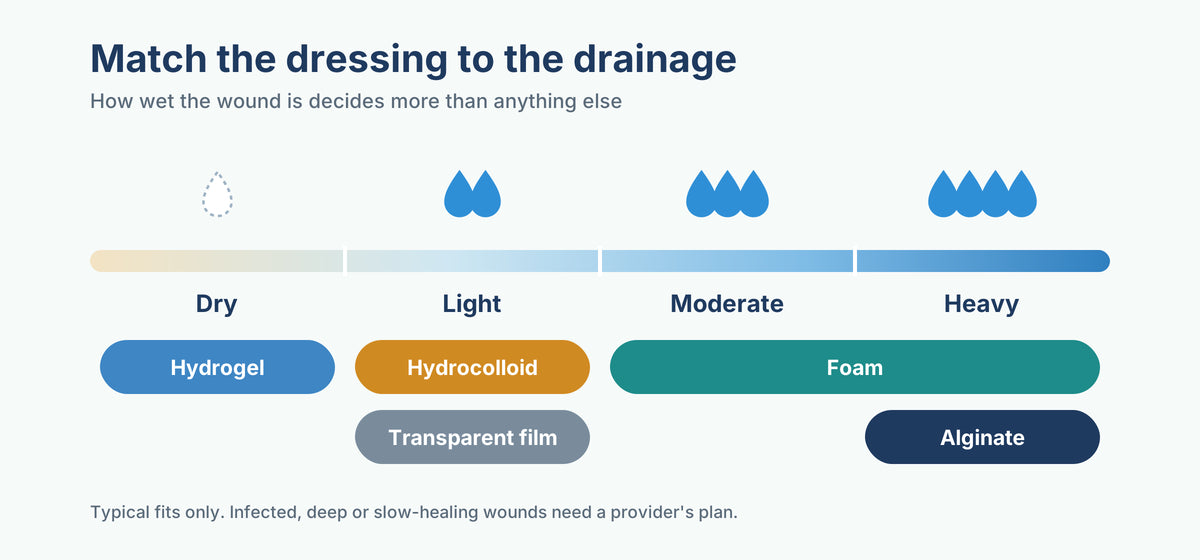
The quickest way to narrow your choice is drainage: hydrogel for dry, hydrocolloid for light, foam for moderate to heavy, and alginate for heavy drainage in deep wounds.
| Dressing | Best drainage level | What it does | Needs a cover? | Typical change | Avoid on |
|---|---|---|---|---|---|
| Hydrogel | None to minimal | Adds moisture, softens dead tissue | Usually yes | Every 1 to 3 days | Heavily draining wounds |
| Hydrocolloid | Light to moderate | Seals and forms a gel over the wound | No (self-adhesive) | Every 2 to 4 days | Infected or necrotic wounds, heavy drainage |
| Foam | Moderate to heavy | Absorbs fluid, cushions | No if bordered | Daily to a few times a week | Dry wounds |
| Alginate | Moderate to heavy | Turns to gel, fills deep spaces, helps minor bleeding | Yes, always | Every 1 to 3 days | Dry wounds, eschar |
Sources for this table: notes 3 and 4. Change times are typical ranges. Your care team's instructions and the product label come first.
Other Types of Wound Dressings Worth Knowing
Foam, alginate, hydrocolloid and hydrogel cover most home wound care, but a few other dressing types fill specific gaps.
| Dressing type | What it is | Best for | Typical change |
|---|---|---|---|
| Transparent film | Thin, clear adhesive sheet that lets you see the wound3 | Shallow wounds with minimal drainage, closed wounds, IV sites3 4 | Every few days, up to 7 days3 |
| Gauze | Woven or non-woven cotton pads and rolls | Packing, covering, or as a secondary dressing; it does not hold moisture on its own3 | Several times a day when used for packing3 |
| Collagen | Pads or powders made from collagen | Wounds with light to moderate drainage that have stalled4 | Can stay up to 7 days4 |
| Contact layer | Thin silicone or mesh liner placed directly on the wound | Keeps the outer dressing from sticking to fragile tissue4 | Left in place through several outer-dressing changes4 |
Antimicrobial and honey dressings
Some dressings add silver or iodine to help control bacteria on the wound surface.3 Others use medical-grade honey. They are usually chosen for wounds a clinician believes are at risk of infection. Evidence for these materials is still debated, and one major U.S. coverage policy does not yet recognize silver or honey as proven dressing materials.4 Ask your provider whether one is right for your wound.
How to Choose the Right Wound Dressing for Your Wound Type
Start with what you see. This quick guide matches common wound situations to the dressing types that usually fit them. Your provider may choose differently based on things you can't see at home.
| What the wound looks like | Dressing types that usually fit |
|---|---|
| Dry, or covered in dry yellow slough | Hydrogel, with a secondary cover3 |
| Shallow, with light drainage | Hydrocolloid or transparent film3 |
| Moderate to heavy drainage | Foam or alginate3 |
| Deep wound, cavity or tunnel | Alginate rope or foam filler, plus a cover3 4 |
| Pressure injury on a heel or tailbone | Foam or hydrocolloid3 |
| Fragile skin that tears easily | Silicone-adhesive foam or a contact layer under the dressing4 |
| Signs of infection | See a provider first; avoid sealing it under a hydrocolloid or film3 |
Tips for dressing changes at home
- Wash your hands before every change.11
- Clean the wound as your provider directed. For minor cuts and scrapes, running water is usually enough. Hydrogen peroxide and iodine can irritate wounds.9
- Size the pad about 2 inches larger than the wound, which leaves about 1 inch of margin on each side.4
- Use one primary dressing at a time. Don't layer an alginate under a hydrogel.4
- Write the date on the outer dressing so everyone knows when it was last changed.
When to call a healthcare provider
Home dressings are for wounds that are healing the way they should. If you spot any of these, stop guessing and call your provider:9
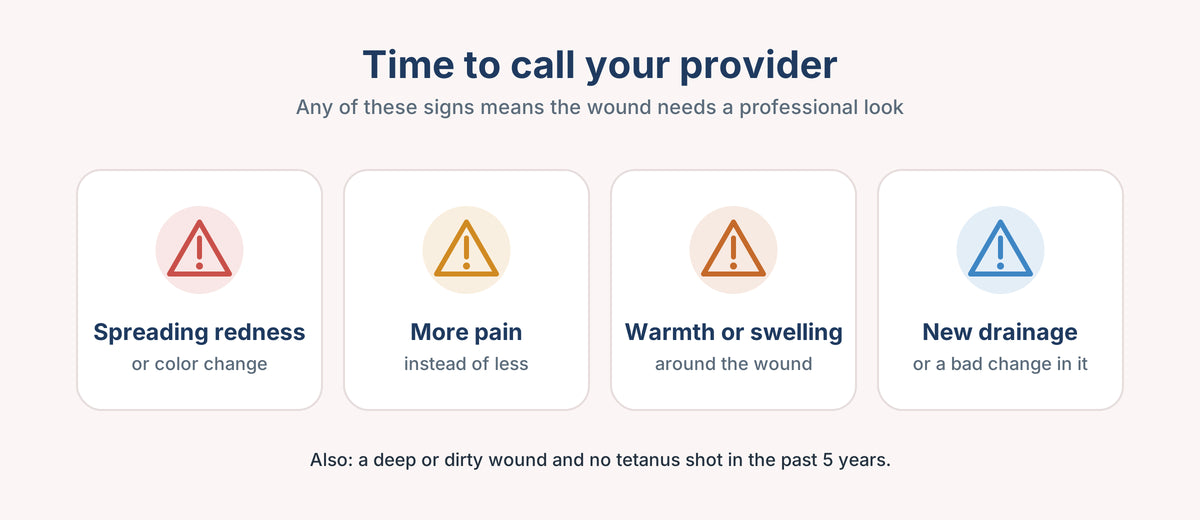
- Spreading redness or color change around the wound
- More pain instead of less, or new warmth and swelling
- New or worsening drainage
- A deep or dirty wound and no tetanus shot in the past 5 years
Also check in before treating a wound at home if it's getting bigger, has stopped improving, or is on the foot of someone with diabetes or poor circulation.
The Bottom Line on Choosing a Wound Dressing
Forget the marketing on the box. Match the dressing to the drainage: hydrogel for dry, hydrocolloid for light to moderate drainage, foam for moderate to heavy, and alginate for heavy drainage in deep wounds. And as the wound heals and dries up, expect the dressing to change with it.
Once your care team has pointed you to a dressing type, compare sizes, borders and brands in one place.
Sources
- According to a 2023 analysis of Medicare claims data in the Journal of Medical Economics. Source ↩
- According to a 2015 review in Open Medicine describing a 1962 study published in Nature. Source ↩
- According to StatPearls, "Wound Dressings," NIH National Library of Medicine, last updated January 2024. Source ↩
- According to the Centers for Medicare & Medicaid Services, Local Coverage Determination L33831, Surgical Dressings, revision effective January 1, 2024. Source ↩
- According to the Agency for Healthcare Research and Quality. Source ↩
- According to a 2015 randomized trial in the International Wound Journal (the Border Trial), funded by the dressing manufacturer. Source ↩
- According to a 2013 Cochrane review of alginate dressings for diabetic foot ulcers. Source ↩
- According to a 2013 Cochrane review of hydrocolloid dressings for diabetic foot ulcers. Source ↩
- According to the National Pressure Ulcer Advisory Panel's revised pressure injury staging system, published in 2016 in the Journal of Wound, Ostomy and Continence Nursing. Source ↩
- According to a 2013 Cochrane review of hydrogel dressings for diabetic foot ulcers. Source ↩
- According to Mayo Clinic, "Cuts and scrapes: First aid." Source ↩
About the author: Ferdinand Soliman runs Medicinal Supplies and writes our wound care guides. Each guide is built from manufacturer instructions, Medicare coverage rules and peer-reviewed research, and every claim links to its source in the notes above.
Medical disclaimer: This article is for general education only and is not medical advice. It does not replace an evaluation by a doctor, nurse or certified wound care specialist. Wounds that are deep, infected, slow to heal, or related to diabetes or poor circulation need professional care. Always follow your healthcare provider's instructions and the product label when choosing and changing a dressing. Medicinal Supplies sells the wound care products mentioned in this article.